


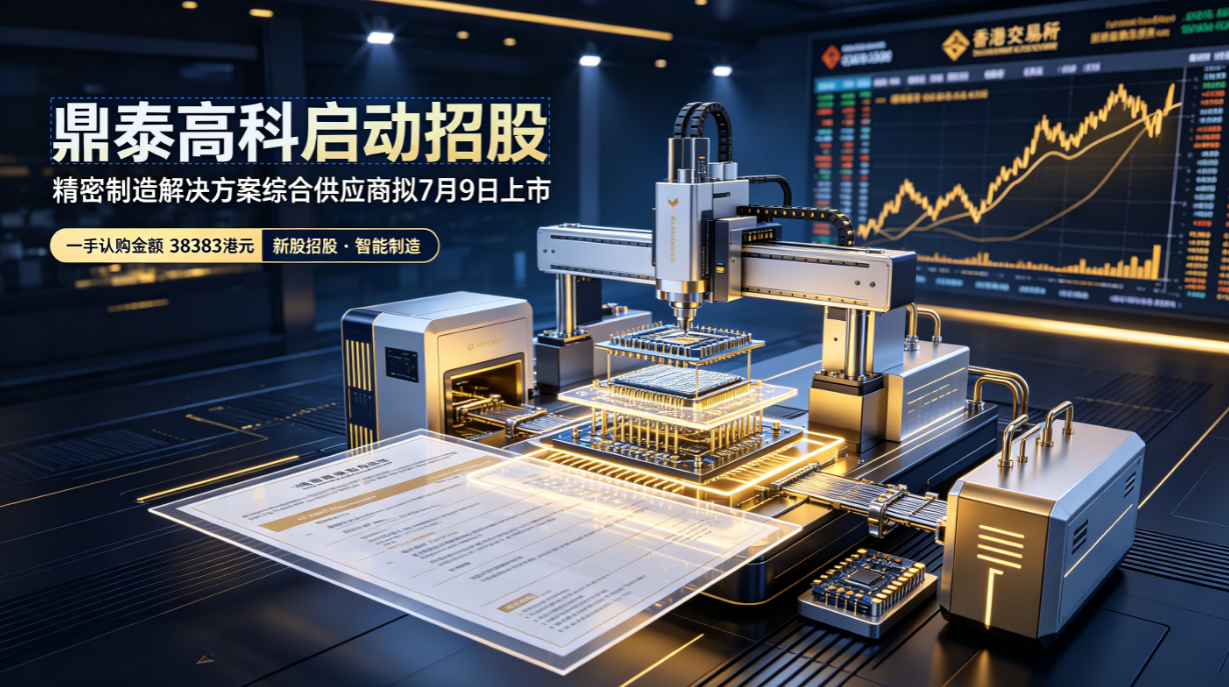
Summary: DingTai High Tech (01377.HK) has launched its IPO, highlighting its precision manufacturing platform, PCB drill bits, intelligent equipment, and global expansion strategy.
DingTai High Tech (01377.HK) IPO: A Precision Manufacturing Platform at the Core of PCB Industry Upgrading
Keywords: DingTai High Tech, 01377.HK, IPO, PCB drill bits, precision manufacturing, printed circuit board, intelligent equipment, global capacity expansion, manufacturing upgrade
DingTai High Tech (01377.HK) has officially launched its IPO, with the offer period running from June 30 to July 6 and a planned listing date of July 9. The company proposes to issue approximately 12.632 million shares globally, marking an important capital market milestone for a business that operates deep inside the value chain of the global printed circuit board (PCB) industry.
At first glance, PCB tooling may sound like a niche segment. In reality, it sits at one of the most technically demanding and strategically important layers of electronic manufacturing. As the world’s electronics supply chain becomes more miniaturized, more integrated, and more performance-sensitive, the precision, durability, and efficiency of PCB tools are increasingly becoming a decisive competitive factor.
A company built around precision manufacturing
DingTai High Tech describes itself as a leading integrated provider of precision manufacturing solutions. Its business spans the critical stages of PCB manufacturing, particularly drilling, milling and shaping, and other related precision processes, while also extending to materials and intelligent equipment.
This is an important positioning. Rather than serving as a single-product supplier, the company aims to provide a more complete solution set across multiple process nodes. That matters because PCB manufacturers increasingly value not only tool performance, but also consistency across production lines, process integration, and supply reliability.
According to Frost & Sullivan data cited by the company, DingTai High Tech is the world’s largest PCB drill bit supplier by sales volume. In a market where production precision directly influences yield, tool life, and throughput, scale is not merely a revenue metric—it often reflects accumulated manufacturing expertise, product standardization capability, and customer trust.
Why PCB tooling matters more than most investors realize
PCB is widely regarded as the “mother of the electronics industry.” That phrase is not just a slogan. Virtually every modern electronic device—smartphones, automotive electronics, servers, industrial controllers, medical instruments, and AI hardware—depends on PCBs as the carrier that connects, powers, and organizes circuits.
Within this industry, tooling is one of the foundational technologies that determines how far the manufacturing process can advance. PCB-specialized cutting tools, especially drill bits and milling tools, affect:
- Hole quality and precision
- Tool wear and replacement frequency
- Production efficiency and line uptime
- Manufacturing cost per board
- Delivery cycle stability
- Compatibility with advanced PCB designs
As PCB designs become denser and more complex, the technical requirements on tooling rise sharply. High layer count boards, HDI boards, and advanced substrates demand higher drilling accuracy, better heat resistance, and longer tool life. That means a supplier with strong materials science, process engineering, and quality control capabilities may enjoy a durable competitive edge.
From a broader industrial perspective, tools are not just consumables; they are a transmission mechanism through which upstream technology improvements influence downstream product performance. In that sense, DingTai High Tech is positioned at a leverage point in the electronics manufacturing ecosystem.
Financial performance: strong top-line growth and expanding profitability
DingTai High Tech’s financial performance reflects that structural demand. According to the information provided, the company’s revenue increased from RMB 1,295.1 million in 2023 to RMB 1,552.6 million in 2024, representing growth of 19.9%. Revenue then rose further to RMB 2,084.2 million in 2025, up 34.2% year-on-year.
Over the 2023–2025 period, revenue posted a compound annual growth rate (CAGR) of 26.9%. For a manufacturing company, that is a notable pace, especially in a segment where growth is typically constrained by industrial cycles, customer qualification processes, and capacity expansion requirements.
Gross profit also expanded meaningfully. It increased from RMB 454.1 million in 2023 to RMB 538.5 million in 2024, then surged 56.5% to RMB 843.0 million in 2025. This translated into a 36.3% CAGR for gross profit over the same period.
What does this tell us?
First, the company appears to be benefiting not only from volume growth but also from an improving product mix or better operating efficiency. Second, the faster growth in gross profit versus revenue suggests that the business may have been gaining some operating leverage, although investors should still examine margin sustainability, raw material sensitivity, and customer concentration in the prospectus.
In precision manufacturing, sustained margin expansion usually depends on three things: product differentiation, process efficiency, and customer stickiness. If DingTai High Tech can continue to strengthen these capabilities, its profitability profile may remain attractive even as it scales.
IPO structure and capital deployment: scaling beyond the domestic base
The company expects net proceeds of approximately HK$4.665 billion from the global offering, based on the prospectus assumptions and assuming the over-allotment option is not exercised, with an offer price of HK$380.
The proposed use of proceeds is strategically aligned with the company’s business model:
- 67.5% for advancing global capacity布局 and expanding global business
- 10.0% for R&D investment in frontier technologies
- 10.0% for strategic acquisitions and investments
- 2.5% for building a company-wide digital and intelligent operations system
- 10.0% for working capital and general corporate purposes
This allocation suggests that DingTai High Tech is not treating the IPO merely as a financing event. Instead, it appears to be using the listing as a platform for international capacity expansion, technology upgrading, and organizational modernization.
That is especially relevant in the current manufacturing environment. PCB customers increasingly seek suppliers that can provide:
- stable capacity across multiple geographies,
- rapid response to demand shifts,
- higher automation and traceability,
- and continuous tool innovation.
If the company can use fresh capital to build a more globally distributed and technologically advanced manufacturing base, it may improve its resilience against cyclical shocks and better serve multinational customers.
Technology depth as the real long-term moat
In precision tooling, the competitive battlefield is often invisible to end users. Yet behind every incremental gain in production yield there may be years of materials testing, coating optimization, geometry refinement, and process control.
For a company like DingTai High Tech, technology depth may come from several layers:
1. Materials engineering
Drill bits and related tools must withstand high-speed rotation, thermal stress, and repeated friction. Better materials and coatings can significantly extend tool life and improve stability.
2. Process know-how
Precision fabrication requires consistency at scale. Small deviations in geometry or surface treatment can lead to major performance differences in high-end PCB applications.
3. Application-specific customization
Different PCB categories require different tooling parameters. A supplier that can quickly adapt tools to customer process conditions is more likely to embed itself deeply in the production chain.
4. Intelligent manufacturing
The move toward digital operations, automation, and data-driven quality control can reduce defect rates, improve traceability, and enhance production planning.
These capabilities are difficult to build overnight. That is why companies with long accumulated know-how often enjoy a degree of structural defensibility, even in an otherwise fragmented manufacturing landscape.
Industry backdrop: electronics upgrading creates structural demand
The timing of the IPO is also notable. As global electronics manufacturing evolves, PCB specifications continue to move upward. Growth areas such as AI servers, electric vehicles, industrial automation, 5G infrastructure, and high-performance consumer electronics all place greater demands on PCB quality and reliability.
This trend supports demand for:
- high-precision drilling solutions,
- advanced milling and shaping tools,
- durable consumables,
- and intelligent production equipment.
In addition, supply chain diversification has become a strategic priority for many electronics manufacturers. Customers are increasingly evaluating not only unit cost, but also supply continuity, technical support, and geographic flexibility. For a supplier with ambitions to expand globally, this creates an opportunity to capture more international business—provided it can maintain quality and service standards across markets.
Key considerations for investors
Despite the attractive growth profile, investors should also keep a few factors in mind.
First, the PCB tooling industry is tied to broader electronics manufacturing cycles. A slowdown in downstream demand could pressure utilization and order growth.
Second, raw material costs and manufacturing efficiency may affect margins. Precision tools are highly sensitive to input quality and process stability, so cost control is crucial.
Third, global expansion is opportunity-rich but execution-intensive. Building overseas capacity, integrating acquisitions, and managing cross-border operations will require strong governance and disciplined capital allocation.
Finally, as the company expands its product scope into materials, equipment, and digital operations, investors will want to see whether management can maintain focus and preserve the core competitiveness that made the business successful in the first place.
Conclusion: a manufacturing story with technology at its center
DingTai High Tech’s IPO is more than a capital market event. It is a case study in how a specialized industrial company can position itself at the intersection of precision manufacturing, electronics upgrading, and global supply chain transformation.
Its leadership in PCB drill bits, its expanding solution portfolio, and its strong revenue and gross profit growth all indicate that the company is operating in a segment with meaningful technological barriers and long-term industrial relevance. The proposed use of proceeds further suggests a clear strategic intent: to scale globally, invest in frontier technologies, and deepen digital and operational capabilities.
For investors seeking exposure to the manufacturing upgrade theme, DingTai High Tech represents a company whose value proposition is rooted not in broad industrial generality, but in highly technical, process-critical expertise. In a world where electronic devices continue to shrink in size and grow in complexity, that kind of precision may prove increasingly valuable.